Logistic Regression Train (LR Train)
Introduction
Logistic Regression
Logistic Regression (LR) is actually a classification problem, although it names itself as "regression". It is mainly used for the binary classification, by utilizing the Logistic Function - Sigmoid. Obviously, its value locates within (0, 1). Usually, it takes 0.5 as the threshold, below which it classifies the observed set of inputs as class "0", and vice versa. Sigmoid function is presented as a pretty S-curve.
Logistic regression (LR) is a statistical learning method widely used for classification problems, especially in binary classification scenarios. Despite the word "regression" in its name, it is essentially a classification model that makes classification decisions by modeling the probability of events. The core of logistic regression is to predict the probability of an event occurring. Using a probability threshold (usually 0.5), samples can be classified into two categories: those with probability ≥ 0.5 are classified as class "1", otherwise as class "0".
Sigmoid Function
The primary role of Sigmoid function is to map any real-valued input to a value between 0 and 1, making it ideal for modeling probabilities. It is presented as a S-shaped curve.
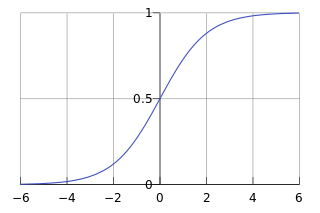
The formula of Sigmoid function is as follows: $$ \sigma(z) = \frac{1}{1 + e^{-z}} $$
Logistic Regression Classifier aims at learning a binary classification model from the features of the input training data. The model takes the linear combination of the input feature as the variable,\theta_0+\theta_1x_1+,\ldots,+\theta_nx_n= \sum_{i=1}^n \theta_ix_i,where x_0 is always 1. We can also present it as \theta^Tx. Putting it into the sigmoid function, we get a prediction model as: $$ h_\theta(x)=g(\theta^Tx)=\frac{1}{1+e^{-\theta^Tx}} $$ LR finally maps the combination variable to (0, 1) to determine the class of the input features.
In order to train such a logistic model, we need to build a reasonable loss function. But before that, we firstly define the probability of classes (0 or 1) as follows:
$$ \begin{equation} \begin{aligned}&P(y=1\mid x;\theta)=h_\theta(x)\&P(y=1\mid 0;\theta)=1-h_\theta(x)\end{aligned}\end{equation} $$ It means for a set of input features denoted as x_i and their correspondent labels y_i, the probability of y_i = 1 under x_i is p_i and hence the probability of y_i = 0 is 1-p_i. Therefore, we can combine the two cases and get a unified probability function as:
$$ P(y)\mid x;\theta)=(h_\theta(x))^y(1-h_\theta(x))^{1-y} $$ Further, for m number of input features x_1, x_2, ...... , x_m, the joint probability is simply the multiplication of the probability of each y_i under x_i, as follows:
$$ L(\theta)=\prod_{i=1}^{m}{P=(y_i\mid x_i;\theta)}=\prod_{i=1}^{m}(h_\theta(x_i))^{y_i}(1-h_\theta(x_i))^{1-y_i} $$ The purpose of LR is to obtain an optimal set of parameter set \theta that could lead to the maximum L(\theta). Taking its logarithm form, we get l(\theta) as:
$$ l(\theta)=\log{L(\theta)}=\sum_{i=1}^m \Big(y_i\log h_\theta(x_i)+(1-y_i)\log \big(1-h_\theta(x_i)\big)\Big) $$ If we regard l(\theta) as the loss function, training the LR problem should use gradient ascent manner, because l(\theta) is the larger the better. If we want to minimize the loss function ( to coincide with the mainstream machine learning training method), we can simply use its minus as: J(\theta)=-\frac{1}{m}*l(\theta), and we could use the gradient descent to issue the parameter optimization: \theta_j:=\theta_j-\alpha\frac{\delta}{\delta_{\theta_j}}J(\theta)
where:
Vectorization
The parameter optimization process could be vectorized, which is of great importance in FHE. We could use the following process for the vectorization:
Firstly, we reform the m number input vector x as more fine-grained feature matrix for each observed feature, similar for the output class y and the parameter set \theta:
The linear combination of each feature x_i and the parameter set \theta could then be presented as matrix-vector multiplication. The resulting matrix A is used as input of the sigmoid function g:
E is the error (or loss) between the observed label y (0 or 1) and the predicted probability obtained by the sigmoid function with x. Therefore, the final optimization is presented as follows: $$ \theta_j:=\theta_j-\alpha\frac{1}{m}\sum_{i=1}^m\big(h_\theta(x_i)-y_i)\big)x_i^j=\theta_j-\alpha\frac{1}{m}\sum_{i=1}^me_ix_i^j=\theta_j-\alpha\frac{1}{m}x^{jT} E $$
Implementation
In this section, we will illustrate the implementation of logistic regression in privacy.
- Preprocess the input data
- Compute Sigmoid function ciphertext
- Compute gradient ciphertext
- Update the weight ciphertext
- Repeat step(2)~(4) util the result becomes convergence
Step 1
In step(1), the input matrix is divided into several blocks of 2^n * 2^n for the convenience of the next calculation. For example, the default size of our example input is 780 * 9 , and the output size is 9*1 . The 780 * 9 input matrix is resized into 784 * 16 (49 partitioned matrix of size 2^4 * 2^4 ) where the newly added elements are fulfilled with zeros.
input_matrix := resize(input_matrix)
input_matrix_diagonal := diag(input_matrix)

for partitioned_matrix in input_matrix:
    size = partitioned_matrix.row
    for i in size
        for j in size
            matrix_diagonal[i][j] = matrix[j][(i+j) % size]
First, the training data matrix (the blue blocks in the picture) is extended to a square matrix fulfilling with zeros.
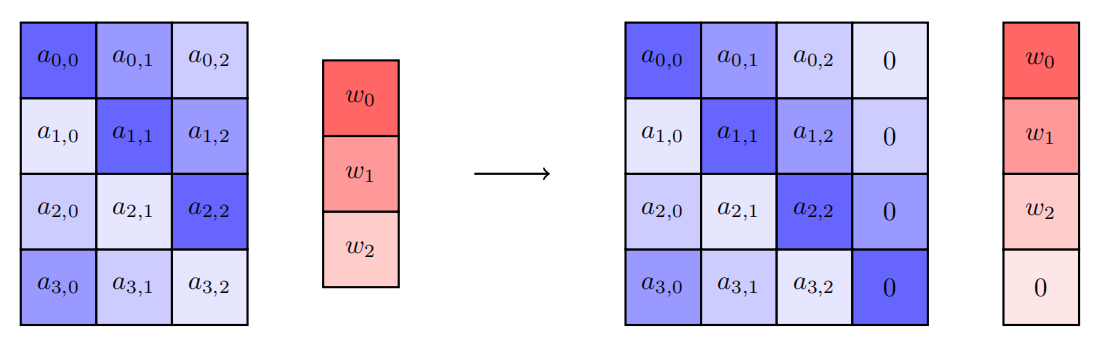
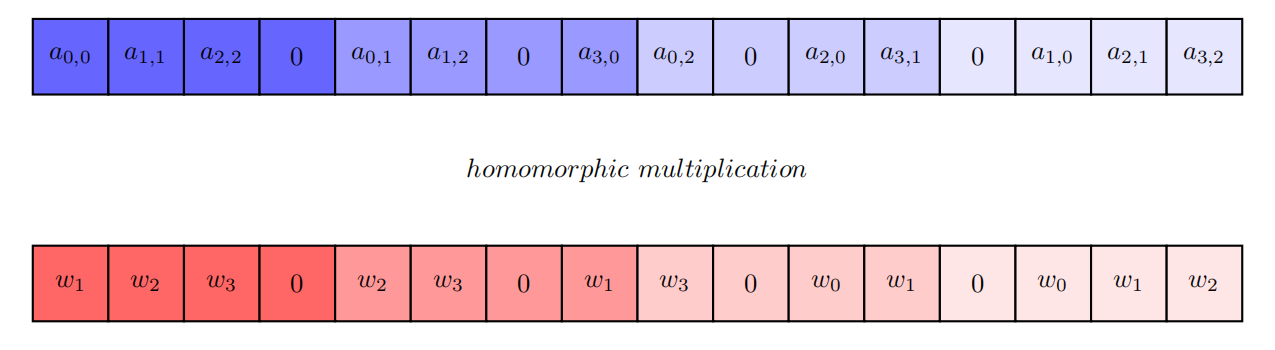
Then the extended training data matrix is packed into a vector. On the other hand, the classification result (the red blocks in the picture) is rotated and extended into a vector where the element corresponds to the extended training data element.
Step 2
In step(2), it computes the Sigmoid function over the input data ciphertext.
ct_tmp = ciph_x_diag * ciph_weight

// accumulate the slots
for i = 0 : slot_size / (block_size)
    for j = 0 : block_size
        for k = 0 : block_size
            ct_res[i * block_size * block_size + j] += ct_tmp[i * block_size * block_size + k * block_size + j]

ct_sigmoid = evaluate_poly_vector(ct_res)
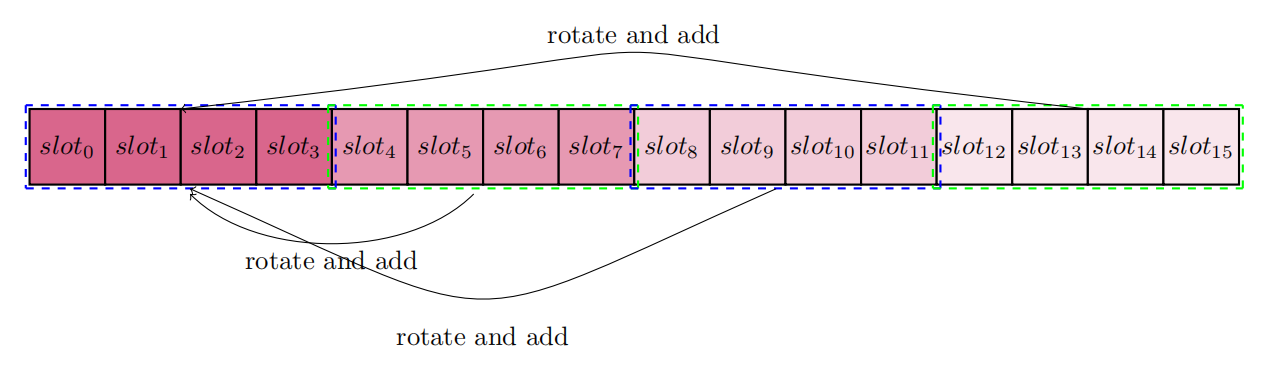
Every block_size * block_size slots is accumulated to the beginning block_size * block_size slots.
Step 3
In step(3), it computes the gradient of \theta . The formula of gradient in plaintext is { grad(\theta_j) = \frac{1}{m}\sum_{i=1}^m\Big(y_i - h_\theta(x_i))\Big)x_{i,j}} .
// computing the gradient ciphertext
for i = 0 : x_tranpose.size()
    ct_tmp = ct_sigmoid * ct_x_transpose[i]
    ct_tmp = accumulate(ct_tmp)
    ct_tmp = ct_tmp * plt(1 0 0 0 0 0 0 ...)    // all the slots in plaintext is 0 except the first slot to be 1
    ct_tmp = rotate(ct_tmp, -i)
    ct_grad += ct_tmp

ct_grad *= (learning_rate / m)
// rotating the gradient ciphertext
ct_grad_shift = ct_grad + rotate(ct_grad, -16)
for i = 1 : block_size
    // the i-th to the (i+block_size)-th slot to be 1
    mask = [0, 0, ... 1, 1, ..., 1, 0, ..., 0]
    ct_tmp = rotate(ct_grad_shift, -i % 16) * mask
    ct_grad += rotate(ct_tmp, 16*i)

for i = 1 : slot_size / block_size
    ct_grad += rotate(ct_grad, i * block_size)
    i <<= 1
Step 4
In step(4), it updates the weight.
ct_weight := ct_weight - ct_gradient * plt_learning_rate
Source Code
void read_file(std::vector<std::complex<double>> &matrix, const std::string& file);
matrix(std::vector<std::complex<double>> &) : output of classification resultfile(const std::string &) : the file which stores the output result
Usage : read the input of training data from the file
void read_file(std::vector<std::vector<std::complex<double>>> &matrix, const std::string& file);
matrix(std::vector<std::vector<std::complex<double>>> &) : input of training datafile(const std::string&) : the file which stores the training data
Usage : read the input of training data from the file
void preprocess(int block_size,
                int block_num,
                std::vector<std::vector<std::complex<double>>> &x,
                std::vector<std::vector<std::complex<double>>> &x_transpose,
                std::vector<std::vector<std::complex<double>>> &x_diag);
block_size(int) : the size of block matrix (partitioned matrix)block_num(int) : the number of block matrix (partitioned matrix)x(std::vector<std::vector<std::complex<double>>> &) : the input matrix of training datax_transpose(std::vector<std::vector<std::complex<double>>> &) : the transposed matrix of training data matrixx_diag(std::vector<std::vector<std::complex<double>>> &) : the diagonal matrix of training data matrix which is used for computing the multiplication of the matrix with the vector
Usage : Preprocessing the training data for further computation.
Ciphertext accumulate_top_n(const Ciphertext &ciph, int n, const CKKSEncoder &encoder,
                            const Encryptor &enc, std::shared_ptr<EvaluatorCkksBase> ckks_eva,
                            const GaloisKeys &rot_keys);
ciph(const Ciphertext &) : the input ciphertextn(int) : the range of accumulationencoder(const CKKSEncoder &) : the encoderenc(const Encryptor &) : the encryptorckks_eva(std::shared_ptr<EvaluatorCkksBase>) : the evaluator for homomorphic computationsrot_keys(const GaloisKeys &) : the rotation key
Usage : It accumulates the top n slots and stores the result into the first slot. It can be expressed by the equation slot[0] = \sum\limits_{i=0}^{n-1}slot[i] . Pay attention that the origin slots in the ciphertext will be changed!
double sigmoid(double x);
x(double) : input value
Usage: It computes the Sigmoid function \frac{e^x}{1+e^x} of input value x.
Ciphertext sigmoid_approx(const Ciphertext &ciph, const PolynomialVector &polys,
                          const CKKSEncoder &encoder, std::shared_ptr<EvaluatorCkksBase> eva,
                          const RelinKeys &relin_keys);
ciph(const Ciphertext &) : the input ciphertextpolys(const PolynomialVector &) : the Sigmoid function expressed by approximate polynomialencoder(const CKKSEncoder &) : the encodereva(std::shared_ptr<EvaluatorCkksBase>) : the evaluator for homomorphic computationsrelin_keys(const RelinKeys &) : the relinearization key
Usage : It computes the sery expansion of the Sigmoid function \frac{e^x}{1+e^x} in ciphertext.
int get_size(int min, int max);
min(int) : the minimum valuemax(int) : the maximum value
Usage : It computes the logarithm of 2 which satisfies to min \le 2^{ret \ value} \le max .
Ciphertext accumulate_block_matrix(const std::shared_ptr<EvaluatorCkksBase> eva, const GaloisKeys &rot_key, const Ciphertext &ciph, int block_size);
eva(const std::shared_ptr<EvaluatorCkksBase>) : the evaluator for homomorphic computationsrot_key(const GaloisKeys &) : the rotation keysciph(const Ciphertext) : the ciphertextblock_size(int) : the size of block matrix (partitioned matrix)
Usage : It accumulates every block_size slots into the beginning block_size slots. For i \in [0, block\_size - 1] , there exists slot[i] = \sum\limits_{j = 0}^{block\_size - 1}slot[i + j * block\_size] .
Ciphertext accumulate_slot_matrix(const std::shared_ptr<EvaluatorCkksBase> eva, const GaloisKeys &rot_key, const Ciphertext &ciph, int block_size, int block_num);
eva(const std::shared_ptr<EvaluatorCkksBase>) : the evaluator for homomorphic computationsrot_key(const GaloisKeys &) : the rotation keysciph(const Ciphertext &) : the ciphertextblock_size(int) : the size of block matrix (partitioned matrix)block_num(int) : the number of block matrix (partitioned matrix)
Usage : It accumulates every block_size * block_size slots into the beginning block_size * block_size slots. For i \in [0, block\_size * block\_size -1] , there exists slot[i] = \sum\limits_{j = 0}^{block\_num - 1}slot[i + j * block\_size * block\_size] .
std::vector<std::complex<double>> vector_to_block_message(const std::vector<std::complex<double>> &vec, int cnt, int block_size);
vec(const std::vector<std::complex<double>> &) : the input vectorcnt(int) : the firstcntitems of thevecblock_size(int) : the size of block matrix (partitioned matrix)
Usage : It packs the first cnt items of the vec into a vector which looks like:
Performance (TBD)
The environment is as follows:
- System: Ubuntu 20.04.6 LTS
- CPU: Intel(R) Xeon(R) Platinum 8375C CPU @ 2.90GHz
- RAM: 512G