CKKS API
Data Structures
Poseidon Supported parameter data structures, the following is specific to CKKS:
1. CKKS encoding and decoding class : CKKSEncoder 
Description: CKKSEncoder is used to encode and decode message for CKKS scheme.
Functions:
CKKSEncoder(const PoseidonContext &context);
- context (const PoseidonContext &): The context specified by user, which includes the parameters of homomorphic encryption scheme, polynomial degree and security level.
Usage: Creates a CKKSEncoder instance initialized with the specified PoseidonContext.
void encode(const std::vector<std::complex<double>> &values, parms_id_type parms_id, double scale, Plaintext &destination, MemoryPoolHandle pool = MemoryManager::GetPool()) const;

void encode(const std::vector<double> &values, parms_id_type parms_id, double scale, Plaintext &destination, MemoryPoolHandle pool = MemoryManager::GetPool()) const;

void encode(std::complex<double>, parms_id_type parms_id, double scale, Plaintext &destination, MemoryPoolHandle pool = MemoryManager::GetPool()) const;

void encode(double value, parms_id_type parms_id, double scale, Plaintext &destination, MemoryPoolHandle pool = MemoryManager::GetPool()) const;

void encode(int64_t value, parms_id_type parms_id, double scale, Plaintext &destination) const;
- values (const vector<complex
- parms_id (parms_id_type): parms_id specifies the modulus level of the modulus chain to of the result plaintext.
- scale (double): Scaling parameter defining encoding precision.
- destination (Plaintext): The plaintext polynomial to overwrite with the result.
Usage: The packing technique of HE schemes allow us to encrypt multiple messages in a single ciphertext. The encode function encodes either a single complex number or many complex numbers into a plaintext. It appends zeros to the end if the vector size is less than N/2 (N is the polynomial degree).
For a message z \in \mathbb{C}^{\frac{N}{2}} , the coefficients of plaintext polynomial m(X) = \sum_{i=0}^{N-1}m_iX^i can be computed by m = (U;\overline{U})^T (z;\overline{z})= \frac{1}{N}(\overline{U}^T \cdot z + U^T \cdot \overline{z}) where U is the (N/2) ×N Vandermonde matrix generated by {\zeta_j : 0 ≤ j < N/2}.
void decode(const Plaintext &plain, std::vector<double> &destination, MemoryPoolHandle pool = MemoryManager::GetPool()) const;

void decode(const Plaintext &plain, std::vector<std::complex<double>> &destination, MemoryPoolHandle pool = MemoryManager::GetPool()) const;
- plain (const Plaintext &): The plaintext to be decoded.
- destination (std::vector\<double>&, std::vector\<std::complex\<double>>&): A number vector to store the message.
Usage: The decode function decodes a plaintext polynomial into a vector of numbers. The decoding result is fulfilled with zeros to size N/2.
For a plaintext m \in \mathbb{R}^N , the corresponding message z can be computed by (z;\overline{z}) = (U;\overline{U}) \cdot m which is the inverse of encoding.
2. Plaintext matrix class : MatrixPlain 
Description: MatrixPlain is a class for storing plaintext matrix information.
MatrixPlain()
        : log_slots(0), n1(0), level(0),
          scale(1.0), rot_index{}, plain_vec_pool{sz, std::map<int, Plaintext>()}, read_idx(0),
          write_idx(0), is_precompute(false)
Members:
-
LogSlots (uint32_t): Indicates the logarithm to 2 of the number of matrix elements.
-
N1 (uint32_t): Indicates the number of rows in a matrix.
-
level (uint32_t): Indicates the level of the ciphertext module chain in which the matrix resides.
-
scale (double): Indicates the scaling factor of the matrix.
-
rot_index (vector
):Indicates the rotation index of a matrix element in a polynomial. -
plain_vec (map
3. Group of Plaintext matrix in linear transform : LinearMatrixGroup 
Description: LinearMatrixGroup is a class for storing a group of plaintext matrix information.
Functions:
LinearMatrixGroup() = default;
Usage: Creates an LinearMatrixGroup instance initialized.
vector<MatrixPlain> &data();
Usage: The function is used to get the vector of MatrixPlain.
vector<int> &rot_index();
Usage: The function is used to get all rotate index.
void set_step(uint32_t step)
- step (uint32_t): The number of modulus used during encoding matrix message to plaintext.
Usage: The function is used to set the scaling factor of Matrix Plain. When step is 1, the scaling factor is one modulus.
const int step() const;
Usage: The function get the step.
4. Homomorphic DFT Parameter class : HomomorphicDFTMatrixLiteral 
Description: Parameter config class for homomorphic DFT.
Functions:
HomomorphicDFTMatrixLiteral(LinearType type, uint32_t log_n, uint32_t log_slots,
                            uint32_t level_start, vector<uint32_t> levels,
                            bool repack_imag_to_real = false, double scaling = 1.0,
                            bool bit_reversed = false, uint32_t log_bsgs_ratio = 0);
- type (LinearType): indicating the matrix type (DFT or IDFT).
- log_n (uint32_t): The logarithm of polynomial degree.
- log_slots (uint32_t): The logarithm of plaintext slots.
- level_start (uint32_t): The start level in modulus chain.
- levels (vector
): The levels of DFT process. - repack_imag_to_real (uint32_t): Allowing repackage image message to real message ciphertext.
- scaling (uint32_t): The scaling factor of HomomorphicDFT process.
- bit_reversed (uint32_t): Allow bit reversed (only support false now).
- log_bsgs_ratio (uint32_t): The ratio of BSGS matrix (1 is recommend).
Usage: HomomorphicDFTMatrixLiteral class constructs the DFT or IDFT matrix for bootstrapping.
void create(LinearMatrixGroup &mat_group, CKKSEncoder &encoder,uint32_t step);
- mat_group (LinearMatrixGroup &): The LinearMatrixGroup.
- encoder (CKKSEncoder &): The CKKSEncoder.
- step (uint32_t): The number of modulus used during encoding matrix message to plaintext.
Usage: Create the LinearMatrixGroup object according to the HomomorphicDFTMatrixLiteral parameter.
5. Polynomial class : Polynomial 
Description: The polynomial coefficients class in homomorphic polynomial evaluator.
Polynomial(const vector<complex<double>> &data, int a, int b, int max_deg,
           PolynomialBasisType basis_type, bool lead = false)
- data (const vector
- a (int): upper bound scope of series expansion
- b (int): lower bound scope of series expansion
- max_deg (int): the highest degree of polynomial
- basis_type (PolynomialBasisType): the polynomial is to be evaluated in Monomial type or Chebyshev type.
- lead (bool): whether contains the highest degree term of the polynomial
6. PolynomialVector class : PolynomialVector 
Description: A vector of polynomials class in homomorphic polynomial evaluator.
Functions:
PolynomialVector() = default;
Usage: Construct an empty polynomial vector.
PolynomialVector(const vector<Polynomial> &polys, const vector<vector<int>> &indexs, bool lead = true);
- polys (const vector
&): The Polynomials. - indexs (const vector
- lead(bool): Whether is lead or not.
Usage: Construct a polynomial vector.
PolynomialVector(const PolynomialVector ©) = default;
- copy (const PolynomialVector ©): The Polynomial.
Usage: Copy a given PolynomialVector to the current one.
PolynomialVector(PolynomialVector &&source) = default;
- source (Polynomial &&): The Polynomial.
Usage: Moves a given PolynomialVector to the current one
PolynomialVector &operator = (const PolynomialVector &assign);
- copy (const PolynomialVector ©): The Polynomial.
Usage: Copy constructor.
PolynomialVector &operator = (PolynomialVector &&assign) = default;
- source (Polynomial &&): The Polynomial.
Usage: Move constructor.
vector<Polynomial> &polys();
Usage: Gets the Polynomials of PolynomialVector.
vector<vector<int>> &index()
Usage: Gets the PolynomialVector index.
7. Homomorphic Mod polynomial class : EvalModPoly 
Description: Parameter config class for homomorphic mod.
Functions:
EvalModPoly(const PoseidonContext &context, SineType type, double scaling_factor, uint32_t level_start, uint32_t log_message_ratio, uint32_t double_angle, uint32_t k, uint32_t arcsine_degree, uint32_t sine_degree);
- context (const PoseidonContext &): The PoseidonContext.
- type (SineType): Cosine Discrete, Sine Continuous or Cosine Continuous.
- scaling_factor (double): The scaling factor of HomomorphicMod process.
- level_start (uint32_t): The start level in modulus chain.
- log_message_ratio (uint32_t): The logarithm of message ratio.
- double_angle (uint32_t): The num of double angle.
- k (uint32_t): The rang if Chebyshev.
- arcsine_degree (uint32_t): arcsine poly degree.
- sine_degree (uint32_t): sine poly degree.
Usage: Constructs homomorphic mod parameters.
Evaluation Functions
1. Addition between ciphertexts : add
void add(Ciphertext &ciph1, Ciphertext &ciph2, Ciphertext &result);
- ciph1 (Ciphertext): representing a ciphertext.
- ciph2 (Ciphertext): representing another ciphertext.
- result (Ciphertext): storing the computation result.
Usage: add computes result = ciph1 + ciph2 .
2. Addition of ciphertext and plaintext : add_plain
void add_plain(Ciphertext &ciph, Plaintext &plain,Ciphertext &result);
- ciph (Ciphertext): representing the addend.
-
plain (Plaintext): representing the other addend.
-
result (Ciphertext): storing the addition result.
Usage: add_plain computes result = ciph + plain .
3. Subtraction between ciphertexts : sub
void sub(Ciphertext &ciph1, Ciphertext &ciph2, Ciphertext &result);
- ciph1 (Ciphertext): representing the minuend.
-
ciph2 (Ciphertext): representing the subtrahend
-
result (Ciphertext): storing the computation result.
Usage: sub computes result = ciph1 - ciph2.
4. Multiplication between ciphertexts : multiply ( only software)
void multiply(const Ciphertext &ciph1, const Ciphertext &ciph2, Ciphertext &result) const;
-
ciph1 (Ciphertext): representing a ciphertext.
-
ciph2 (Ciphertext): representing the other ciphertext.
- result (Ciphertext): storing the computation result.
Usage: multiply computes result = ciph1 * ciph2.
5. Relinearization : relinearize ( only software)
void relinearize(const Ciphertext &ciph, Ciphertext &result, const RelinKeys &relin_keys) const;
-
ciph (Ciphertext): representing a ciphertext.
-
relin_keys (RelinKeys): representing the relinearization key.
- result (Ciphertext): storing the computation result.
Usage: relinearize function performs relinearization operation on the ciphertext.
6. Multiplication between ciphertexts : multiply_relin
void multiply_relin(const Ciphertext &ciph1, const Ciphertext &ciph2,
                    Ciphertext &result, const RelinKeys &relin_key) const;
- ciph1 (Ciphertext): representing a ciphertext.
- ciph2 (Ciphertext): representing the other ciphertext.
- result (Ciphertext): storing the computation result.
- relin_key (RelinKeys): A constant reference to a RelinKeys object, representing the relinearization key.
Usage: multiply_relin computes result = ciph1 * ciph2 and relinearize the ciphertext size of result.
7. Multiplication of ciphertext and plaintext : multiply_plain
void multiply_plain(const Ciphertext &ciph, const Plaintext &plain,
                    Ciphertext &result) const;
- ciph (Ciphertext): representing a ciphertext.
- plain (Plaintext): representing a plaintext.
- result (Ciphertext): storing the computation result.
Usage: multiply_plain computes result = ciph * plain.
8. Rescale : rescale
void rescale (const Ciphertext &ciph,Ciphertext &result) const;
- ciph (Ciphertext): A reference to a Ciphertext object, representing a ciphertext.
Usage: rescale performs a rescaling operation on a ciphertext.
9. Ciphertext rotation : rotate
void rotate(const Ciphertext &ciph, Ciphertext &result,
            int step, const GaloisKeys &galois_keys) const;
- ciph (Ciphertext): representing a ciphertext.
- result (Ciphertext): storing the ciphertext after row rotation.
- rot_step (int): An integer representing the rotation step length; a positive value indicates a left rotation while a negative value indicates a right rotation.
- galois_keys (GaloisKeys): representing the galois keys used for row rotation.
Usage: rotate rotates a ciphertext.
10. Conjugation : conjugate
void conjugate(const Ciphertext &ciph, const GaloisKeys &conj_keys, Ciphertext &result) const;
- ciph (Ciphertext): representing the ciphertext to be conjugated.
- conj_keys (GaloisKeys): representing the galois key used for conjugation.
- result (Ciphertext): storing the resulting ciphertext after conjugation.
Usage: conjugate transforms the complex elements of ciphertext into its complex conjugate.
11. Matrix multiplication of ciphertext and plaintext : multiply_by_diag_matrix_bsgs
void multiply_by_diag_matrix_bsgs(const Ciphertext &ciph, const MatrixPlain &plain_mat, Ciphertext &result, const GaloisKeys &rot_key) const;
- ciph (Ciphertext): representing a ciphertext.
- plain_mat (MatrixPlain): representing a plaintext matrix.
- result (Ciphertext): storing the computation result.
- rot_key (GaloisKeys): representing the galois key used for rotations.
Usage: multiply_by_diag_matrix_bsgs multiplies a ciphertext with a plaintext matrix, performing the linear transformation over the ciphertext with the Baby-Step-Giant-Step (BSGS) algorithm to accelerate the operations.
The BSGS algorithm can be performed with the following equation.
notation:
A denotes the plain matrix
z denotes the ciphertext
N_1 is a divisor of N/2 and N_2 is N/2N_1
\odot denotes the Hadamard (component-wise) multiplication between vectors.
\rho(c;s) denotes the rotation of ciphertext c, the rotation step is s .
12. Number Theoretic Transform (forward) : ntt_fwd
void ntt_fwd(const Plaintext &plain, Plaintext &result,
             parms_id_type parms_id = parms_id_zero) const;
void ntt_fwd(const Ciphertext &ciph, Ciphertext &result) const;
- plain (Plaintext): representing a plaintext.
- ciph (Ciphertext): representing a ciphertext.
- id (Ciphertext): target parms_id of plain(only used in BGV and BFV).
- result (Ciphertext / Plaintext): storing the transformed plaintext or ciphertext.
Usage: ntt_fwd performs the Number Theoretic Transform(NTT) on a plaintext or a ciphertext.
13. Number Theoretic Transform (inverse) : ntt_inv
void ntt_inv(const Ciphertext &ciph, Ciphertext &result) const;
- ciph (Ciphertext): representing a ciphertext.
- result (Ciphertext or Plaintext): storing the inverse transformed ciphertext or plaintext.
Usage: ntt_inv performs the Inverse Number Theoretic Transform(INTT) on a plaintext or a ciphertext.
14. Multiplication of ciphertext and constant value : multiply_const
template <typename T, typename = std::enable_if_t<
                      std::is_same<std::remove_cv_t<T>, double>::value ||
                      std::is_same<std::remove_cv_t<T>, std::complex<double>>::value>>
void multiply_const(const Ciphertext &ciph, T const_data, double scale,
                    Ciphertext &result, const CKKSEncoder &encoder) const;
- ciph (Ciphertext): representing a ciphertext.
- constData (double or complex \<double> ): representing a constant or a vector of constant.
- scale (double): the scaling factor.
- result (Ciphertext): A reference to a Ciphertext object, used to store the computation result.
- encoder (CKKSEncoder): A reference to a CKKSEncoder object, representing the encoder and decoder.
Usage: multiply_const computes result = ciph * const.
15. Addition of ciphertext and complex constant : add_const
template <typename T, typename = std::enable_if_t<
                      std::is_same<std::remove_cv_t<T>, double>::value ||
                      std::is_same<std::remove_cv_t<T>, std::complex<double>>::value>>
void add_const(const Ciphertext &ciph, T const_data, Ciphertext &result,
               const CKKSEncoder &encoder) const
- ciph (Ciphertext): representing a ciphertext.
- constData (double or std::complex\<double>): representing a constant or a vector of constant.
- result (Ciphertext): storing the computation result.
Usage: add_const computes result = ciph + const_data.
16. Discrete Fourier Transform on ciphertext : dft
void dft(Ciphertext &ciph, MatrixPlain& plain_mat,
         Ciphertext &result,const GaloisKeys &rot_key);
- ciph (Ciphertext): representing a ciphertext.
- matrix_group (LinearMatrixGroup): representing the group of linear matrices used for the DFT.
- result (Ciphertext): storing the transformed ciphertext.
- rot_key (GaloisKeys): representing the galois key for rotation.
Usage: dft function is used for Discrete Fourier Transform (DFT) of a ciphertext.
17. Dynamic rescale : rescale_dynamic
void rescale_dynamic(const Ciphertext &ciph,Ciphertext &result, double min_scale);
- ciph (Ciphertext): representing a ciphertext.
- result (Ciphertext):representing a ciphertext.
- min_scale (double): representing the given scaling factor.
Usage: rescale_dynamic is used for multiple times of rescale of the ciphertext util the scale becomes satisfied with the min_scale.
18. Polynomial evaluation : evaluate_poly_vector
void evaluate_poly_vector(const Ciphertext &ciph, Ciphertext &destination,
                          const PolynomialVector &polys, double scale,
                          const RelinKeys &relin_key, const CKKSEncoder &encoder) const;
- ciph (Ciphertext): representing a ciphertext.
- destination (Ciphertext): storing the evaluated ciphertext.
- polys (PolynomialVector): representing the given polynomial vector.
- scale (double): representing the given scaling factor.
- relin_key (RelinKeys): representing the encryption key used for relinearization.
- encoder (CKKSEncoder): representing the encoder and decoder.
Usage: evaluate_poly_vector evaluates a polynomial. In detail, the coefficients of Chebyshev or Taylor polynomials are pre-calculated, then the polynomial approximation is calculated.
19. Coefficient to plaintext slot : coeff_to_slot
void coeff_to_slot(const Ciphertext &ciph, const LinearMatrixGroup &matrix_group,
                   Ciphertext &result_real, Ciphertext &result_imag, const GaloisKeys &galoisKeys,
                   const CKKSEncoder &encoder) const;
- ciph (Ciphertext): representing the ciphertext to be transformed.
- matrix_group (LinearMatrixGroup): A reference to a LinearMatrixGroup object, representing the group of linear matrices used for the transformation.
- result_real (Ciphertext): storing the real part of the transformed ciphertext.
- result_imag (Ciphertext): storing the imaginary part of the transformed ciphertext.
- rot_key (GaloisKeys): representing the galois key for rotation.
- conj_key (GaloisKeys): representing the galois key for conjugation.
- encoder (CKKSEncoder): representing the encoder used in the transformation process.
Usage: coeff_to_slot transforms a ciphertext from the coefficient domain to the slot domain. It performs the homomorphic mapping on the ciphertext.
20. Plaintext slot to coefficient : slot_to_coeff
void slot_to_coeff(const Ciphertext &ciph_real, const Ciphertext &ciph_imag,
                   const LinearMatrixGroup &matrix_group, Ciphertext &result,
                   const GaloisKeys &galoisKeys, const CKKSEncoder &encoder) const;
- ciph_real (Ciphertext): representing the real part of the ciphertext to be transformed.
- ciph_imag (Ciphertext): representing the imaginary part of the ciphertext to be transformed.
- matrix_group (LinearMatrixGroup): representing the group of linear matrices used for the transformation.
- result (Ciphertext): storing the transformed ciphertext.
- rot_key (GaloisKeys): representing the galois key for rotation.
- conj_key (GaloisKeys): representing the galois key for conjugation.
- encoder (CKKSEncoder): representing the encoder used in the transformation process.
Usage: slot_to_coeff transforms a ciphertext from the slot domain to the coefficient domain. It performs the inverse homomorphic mapping of coeff_to_slot operation.
21. Evaluate modulo on the ciphertext vector : eval_mod
void eval_mod(Ciphertext &ciph, Ciphertext &result, const EvalModPoly &eva_poly,
              const RelinKeys &relin_key, CKKSEncoder &encoder);
- ciph (Ciphertext): representing a ciphertext.
- result (Ciphertext): storing the ciphertext after the modular arithmetic.
- eva_poly (EvalModPoly): representing the given modular polynomial.
- relin_key (RelinKeys): representing the encryption key used for relinearization.
- encoder (CKKSEncoder): representing the encoder and decoder.
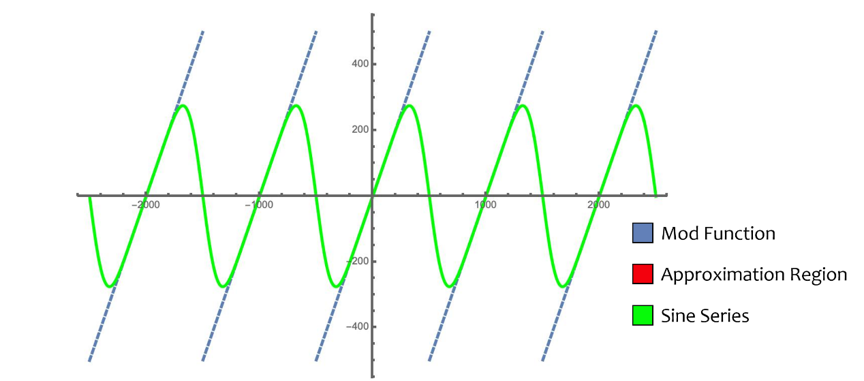
Usage: eval_mod computes modular arithmetic on a ciphertext [t]_q where q is a modulus much larger than the current modulus. Bounded by Kq, [t]_q could be approximately computed by the series expansion of \frac{q}{2 \pi} sin(\frac{2\pi}{q} t) + O(\epsilon^3 q) .
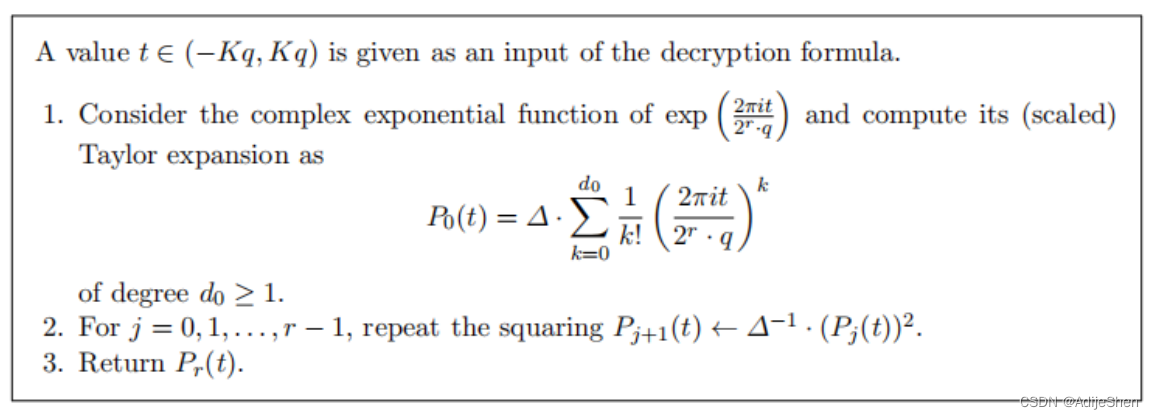
In Poseidon, it first calculates P_0(t) = \Delta \sum\limits_{k=0}^{d} \frac{1}{k!} {(\frac{2 \pi i t} {2^r q})}^k . Then computes P_{j+1}(t) = \Delta^{-1} {(P_j(t))}^2 for r times of iteration to get P_r(t) which is approximately equal to e ^ {\frac{2 \pi i t} {q}} . Finally imaginary part sin(\frac{2 \pi t}{q}) is extracted in the by \frac{P_r(t) - conj(P_r(t))}{2} .
22. Bootstrap : bootstrap
void bootstrap(const Ciphertext &ciph, Ciphertext &result,
               const RelinKeys &relin_keys, const GaloisKeys &galois_keys,
               const CKKSEncoder &encoder, EvalModPoly &eval_mod_poly)
- ciph (Ciphertext): representing a ciphertext.
- result (Ciphertext): storing the bootstrapped ciphertext.
- relin_key (RelinKeys): representing the encryption key used for relinearization.
- galois_keys (GaloisKeys): representing the encryption key used for rotation operations.
- encoder (CKKSEncoder): representing the encoder and decoder.
- eva_poly (EvalModPoly): representing the given modular polynomial.
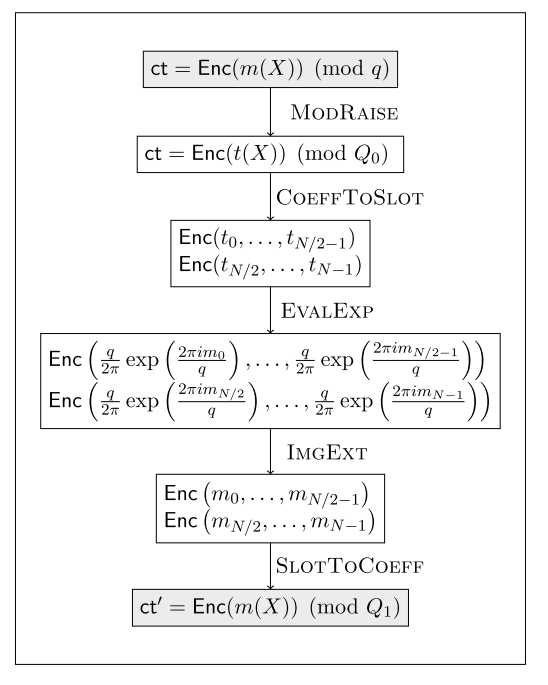
Usage: bootstrap is used for bootstrapping. In poseidon library, bootstrap restore the modulus chain to the original level in the RAISE_MODULUS phase. It consumes several levels to perform the following coeff_to_slot, eval_mod, imaginary part extraction and slot_to_coeff operations. If the original modulus level is too small, the ciphertext after bootstrap may be unavailable.
The process of bootstrapping is illustrated in this picture.