MNIST-CNN
Introduction
MNIST
The MNIST dataset is a training set for image recognition, containing handwritten digits from 0 to 9. It is derived from the National Institute of Standards and Technology (NIST). The training set consists of handwritten digits from 250 different people, with 50% coming from high school students and 50% from staff of the Census Bureau. The test set also contains handwritten digits in the same proportion, but it is ensured that the sets of authors for the test set and the training set are disjoint.
The MNIST dataset contains a total of 70,000 images, with 60,000 in the training set and 10,000 in the test set. Each image is a 28×28 handwritten digit picture of numbers from 0 to 9. All images are in the form of a black background with white characters. The black background is represented by 0, and the white characters are represented by floating-point numbers between 0 and 1. The closer the value is to 1, the whiter the color.
CNN
Convolutional Neural Network (CNN) is a deep learning model proficient in processing grid-structured data such as images. Its core lies in extracting local features through convolution kernels in convolutional layers, reducing data volume and enhancing stability with pooling layers, and then outputting results via fully connected layers. By virtue of local perception and weight sharing, it significantly reduces the number of parameters and can automatically learn hierarchical features from edges to complex objects. It is widely applied in fields like image recognition and object detection, serving as an important foundation for computer vision.
The data is processed to generate a model after being trained in PyTorch, and this application recognizes the data through the model in a confidential state.
Implementation
Basics
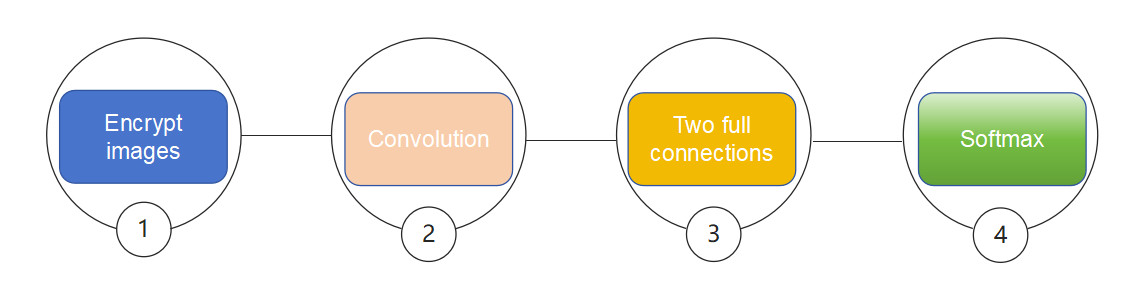
First, the image is in an encrypted state. Then, a convolution operation is performed on the image, followed by two fully connected layers. Finally, softmax is used for normalization to calculate probabilities.
Conv: Convolution with 4 kernels. Shape of the kernel is 7 x 7. Strides are 3 x 3. As shown in the figure, expand the data to be calculated and perform matrix multiplication.
 After the convolution layer multiplies the input vector by the convolution kernel, it performs rotation and accumulation, then obtains an output vector of length 256 through a mask, followed by adding a bias, and finally applies the square activation function.
Activation: Square activation function. Linear Layer 1: Input size: 256. Output size: 64. Activation: Square activation function. Linear Layer 2: Input size: 64. Output size: 10.

Source Code
Variables
conv_kernels(std::vector<std::vector<double>>): Contains 4 convolutional cores, each volume The core has 49 elements. Row-first storage.fc1_weights(std::vector<std::vector<double>>): Full connection weight, size: 256 ∗ 64.fc1_bias_vec(std::vector<double>): Full connection bias, size: 64;fc2_weights(std::vector<std::vector<double>>): Full connection weight, size: 64 ∗ 10.fc2_bias_vec(std::vector<double>): Full connection bias, size: 10;
Validation function
std::vector<double> take_real(std::vector<complex<double>>& input);
Before applying softmax, only the real parts of the vector obtained after decrypting and decoding the ciphertext are taken.
input(std::vector<double>): Input
std::vector<double> matrixVectorMultiply(const std::vector<std::vector<double>>& matrix, const std::vector<double>& vec){}
For verifying the results of the fully connected layer, directly multiply the plaintext input vector (on the right) by the fully connected layer matrix.
matrix(const std::vector<std::vector<double>> &): Fully connected layer matrixvec(const std::vector<double> &): The plaintext input vector
Functions for CNN
std::vector<double> softmax(std::vector<double>& logits);
Calculating probability through normalization.
logits(std::vector<double> &): Input
std::vector<double> preprocess_image(const std::vector<std::vector<int>>& image, size_t ker_size, size_t stride);
Convert the input image (28 ∗ 28) matrix into a convolution-friendly vector, resulting in an im2col-form vector with a length of 3136.
image(const std::vector<std::vector<double>> &): Image dataker_size(size_t): Size of the convolution kernelstride(size_t): Stride
std::vector<float> load_binary_param(const std::string& filename);
First, the model trained by PyTorch will be saved in the model.pt format. Then, the parameters (weights and biases) of each layer are saved separately into bin files, and this function can be used in C++ to read the parameters.
filename(const std::string& ): File name
std::vector<double> replicate(const std::vector<double>& kernel, int windows = 64);
During convolution operations, since the input vector is elongated, the convolution kernel must be duplicated to the same length for multiplication.
kernel(const std::vector<double>&): Convolution kernelwindows(int): The length to be replicated
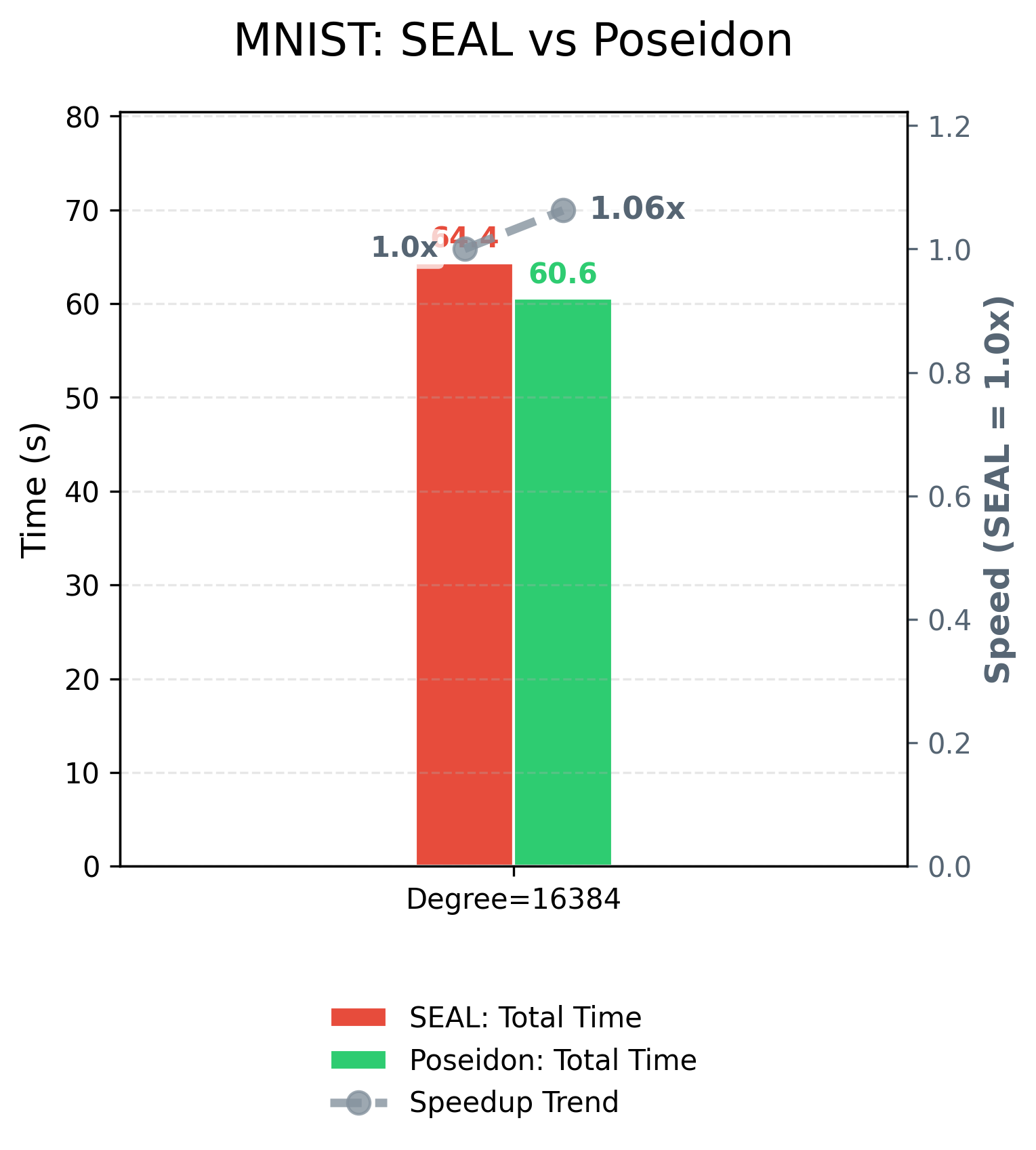
Performance (TBD)
The environment is as follows:
- System: Ubuntu 20.04.6 LTS
- CPU: Intel(R) Xeon(R) Platinum 8375C CPU @ 2.90GHz
- RAM: 512G